
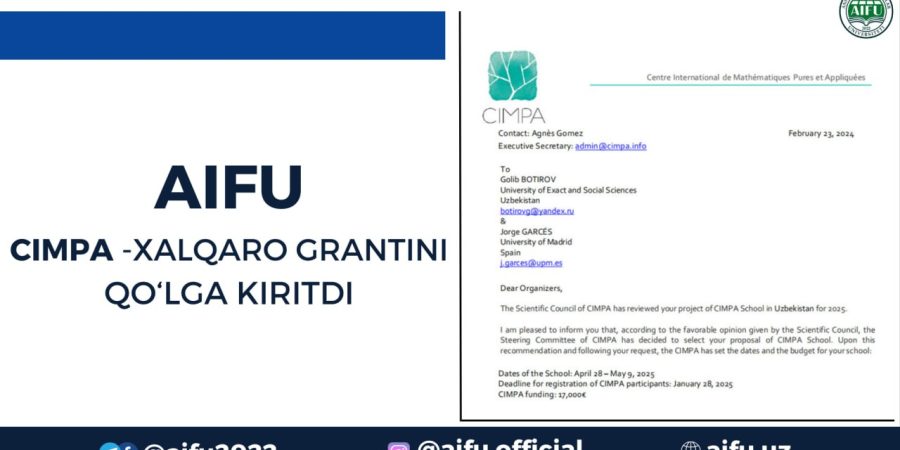
The university of natural and social sciences has won a €17,000 grant from the international center for theoretical and applied mathematics CIMPA (Centre International de Mathématiques Pures et Appliquées). Within the framework of this grant, an international school (CIMPA school) will be organized for mathematicians on the topic “Modern trends of non-associative algebras” from April 28 to May 9, 2025.
The following courses are planned to be taught at the international school.
Course 1: Malihe Yousofzadeh, University of Isfahan (#601–800th
World University Rankings), Iran
Title: Representation of Affine Lie Superalgebras
Course 2: Esther Garcia, Universidad Rey Juan Carlos (#951-1000 in QS World University Rankings), Spain
Title: Jordan Structures in Lie Algebras
Course 3: Yunhe Sheng, Jilin University China, (#502 in QS World University Rankings), China
Title: Deformations and Cohomologies of Algebraic Structures
Course 4: Samuel López, Universidade do Porto (#253 in QS World University Rankings), Portugal
Title: Automorphisms, Derivations and Cohomology of classical and Quantum Algebra
Course 5: Adela Latorre, Polytechnic University of Madrid (#349 in QS World University Rankings), Spain
Title: Geometric Structures on Lie Algebras
Course 6: Daniel Fox, Universidad Politecnica de Madrid (#349 in QS World University Rankings), Spain
Title: Metrized commutative algebras
Course 7: Vladimir Tkachev, Link¨opings University Sweden (#268 in QS World University Rankings), Sweden
Title: Nonassociative algebras in geometry and analysis
Course 8: Jorge Garces, Polytechnic University of Madrid (#349 in QS World University Rankings), Spain
Title: Introduction to linear preservers
Course 9: Antonio Peralta, Universidad de Granada (#403 in QS World University Rankings), Spain
Title: Beyond the Mazur-Ulam theorem: Mankiewicz’s theorem and Tingley’s problem
